
For a regulated operator, payments are one of the most frequent interactions a player has with the brand, and they carry real commercial weight. Yet in most setups, the decisions that determine how payments perform, which acquirer a deposit routes to, whether a declined card is retried, where card tokens are stored, and what each transaction costs, sit in a layer the operator does not directly control.
That layer is the payment decision layer, and it typically lives with a cashier vendor. The arrangement holds up under normal conditions, but the limits show over time: routing changes the operator cannot see, an acquirer degrading during a matchday, costs that climb as volume grows, and market expansion that waits on a vendor's roadmap.
This article looks at where payment control sits in a typical operator setup, why it matters for retention, and how modular orchestration lets an operator take ownership of the decision layer without replacing the systems already in place.
Why payments influence retention
Players judge a sportsbook or casino on its payment experience alongside odds and game selection. The friction is felt at every deposit and, more sharply, at every withdrawal.
UK and EU research from Paysafe puts numbers on it. According to Paysafe, around 68% of players would leave a sportsbook after a poor payment experience. About 40% rank quick, easy payments as their leading reason for choosing a brand, ahead of odds and promotions. And roughly 73% expect real-time payments to be standard at sportsbooks within two years, which raises the bar for what fast, reliable payouts have to deliver.
Read together, these point to a single conclusion: routing, retries, and payout speed are retention levers. An operator with limited control over those decisions has limited control over the retention they drive.
Who owns what today
It helps to be precise about where each piece sits.
The operator owns the licence, the player relationship, and the regulatory liability. The cashier owns the regulated player logic: the player wallet, deposit and withdrawal rules, KYC and AML, responsible-gambling limits, wagering progress, the player ledger, and geolocation. The cashier also holds the payment decision layer: the routing rules, the token vault, and the cost curve.
That last part is the issue. Most cashiers that provide payment infrastructure do their job well, but the arrangement places the levers that set payment performance and payment margin on the cashier's side of the boundary. In practice that shows up as six recurring constraints:
- Limited routing visibility: how a deposit reaches an acquirer is hard to see or adjust.
- Cost that scales with volume: growth raises cost, with little room to bend the curve.
- Expansion tied to a roadmap: entering a new market waits on the vendor's priorities.
- Tokens held in the vendor vault: stored credentials cannot easily be moved.
- Fragmentation across brands: each brand or market runs its own configuration.
- No control over payouts: the strongest retention lever sits outside the operator's hands.
Returning the decision layer to the operator
This is where a payment operating system, like Juspay comes in. Juspay provides a payment orchestration layer that gives the operator direct control of the payment decision layer that today sits inside the cashier. It covers PSP and acquirer connectivity, routing, retries and cascading, along with tokenisation and a PCI-compliant vault, checkout experience suite, payouts, cost observability, and analytics. In practice, the decisions that set payment performance and payment margin move back to the operator's side, which is what addresses the six constraints above.
Juspay sits on top of an operator’s payment stack deeply integrated with its cashier. The player wallet, the limits, KYC and AML, and the rest of the regulated logic stay exactly where they are, and what changes is only the layer beneath.
That leaves a clean ownership map. The operator owns the licence, the player, and the risk. The cashier owns the regulated player logic. Juspay carries the payment decisions, on the operator's behalf and under its control.
From the player's side, the deposit flow barely changes. A player enters an amount, the cashier checks the rules, Juspay selects the route and executes the payment, and the wallet updates on both sides. Idempotency and reconciliation run underneath, so a lost callback never becomes a missed or duplicated deposit. The difference is that the routing and execution steps are now visible and adjustable to the operator.
End to end, the flow looks like this:
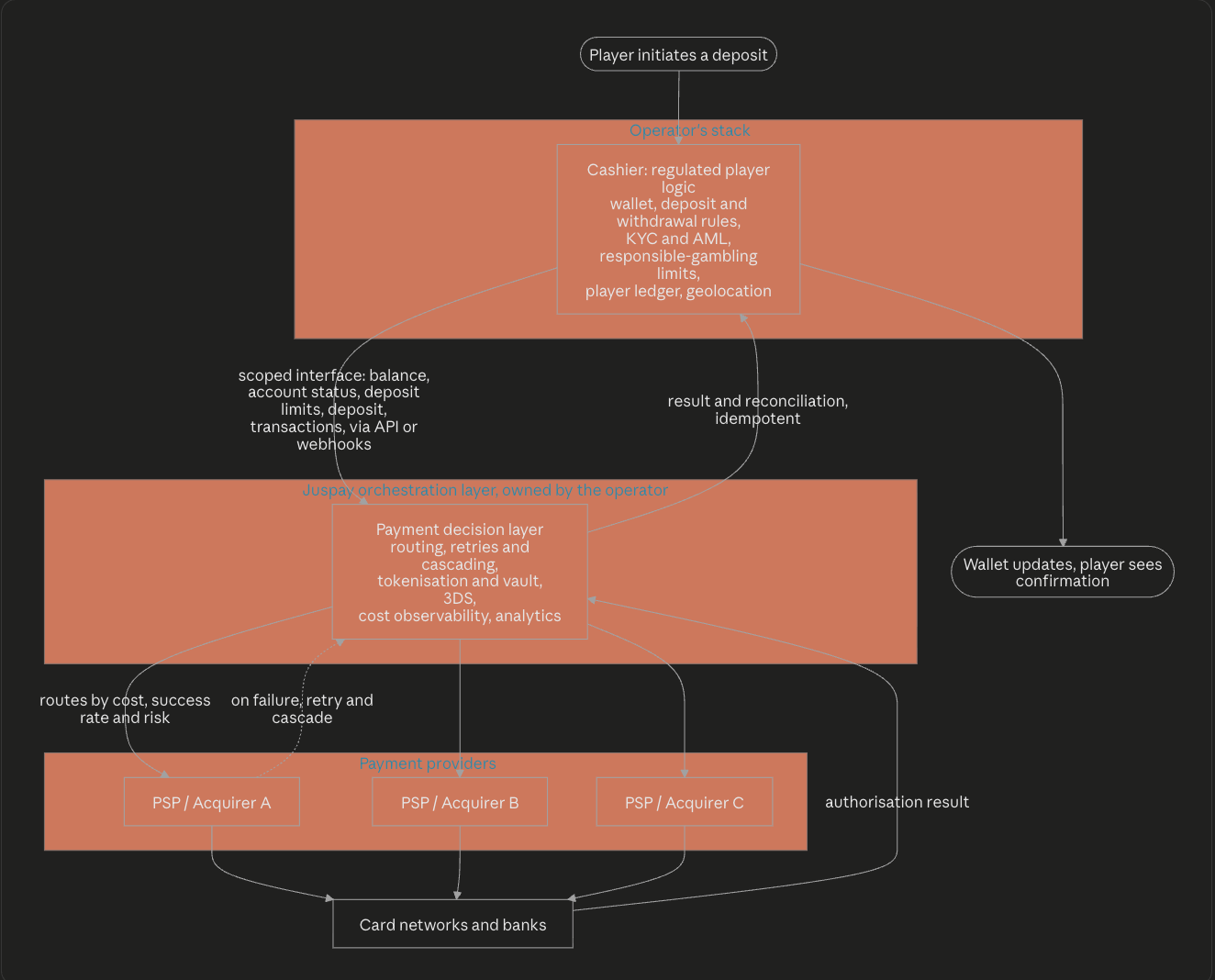
The cashier keeps the regulated player logic and calls the orchestration layer through a scoped interface. Juspay makes the routing and execution decisions, cascades to an alternate route on failure, and returns a reconciled result, while the cashier and the player wallet stay the source of truth for the player state. Withdrawals follow the same path through the payouts module.
Modular by design
Juspay’s payment orchestration platform is composable rather than a single fixed stack. Every capability is a separate building block. Operators only take what they need, add or swap modules, and their existing partners, without rebuilding anything.
Deployment follows each market's rules:
- Self-hosted: in the operator's own cloud or on-premise, in any jurisdiction, so player data stays in-country where the licence requires it.
- Self-hosted with outsourced PCI: the operator runs the stack while Juspay carries the PCI scope.
- Juspay-hosted: fully hosted and operated by Juspay as a managed service.
Data residency is a practical requirement here, not an incidental one. Several gaming licences require player data to stay inside the market, and self-hosting is how an operator meets that while still using orchestration.
The modules that return control
The capabilities offered by Juspay show what owning the decision layer looks like in practice.
Payment routing lets the operator choose the most effective path for each deposit, using least-cost, risk-based, or volume-based logic, with fallback and cascading and custom rules on BIN, issuer, currency, and geography. This is the routing visibility the operator lacks today, turned into a lever it can pull.
BIN intelligence enforces card rules at the BIN level before a transaction reaches an acquirer. The United Kingdom has banned credit cards for gambling since April 2020, under a UK Gambling Commission rule, and several markets restrict card deposits outright. A centralised BIN database, per-geography rules, and BIN-level authorisation performance let the operator honour those rules and route on them.
Cost observability gives invoice-level breakdowns of interchange, scheme, and processing fees, with penalty and downgrade detection and agreed-versus-charged audits. Multi-acquirer operators usually have little visibility into what they actually pay, and this closes that gap.
Payouts are the strongest retention lever, because withdrawal speed is what players judge most. The module supports closed-loop payouts, an AML requirement in most regulated markets, across Faster Payments, SEPA and SEPA Instant, and Visa Direct and Mastercard Send, with payout routing and retries.
Tokenisation gives the operator ownership of the vault and makes stored credentials portable, with network tokens, a bring-your-own token requestor, and vault-to-vault synchronisation.
Fraud and chargeback management matters because operators sit on MCC 7995, under scheme-monitoring thresholds where a bad month has consequences. The module integrates fraud vendors before and after authorisation, runs an in-house trust score, and applies dispute visibility with per-market rules.
The catalogue runs to more than 300 integrations across PSPs, acquirers, and local methods, and a method not yet supported is typically built in around two weeks.
Control shows up when something breaks
The clearest test of who controls payments is what happens on a bad day.
One operator running Juspay orchestration hit a live PSP outage, the kind of acquirer degradation that can turn a busy matchday into a wall of failed deposits. Because monitoring runs per PSP-and-method pair, the failing acquirer was detected automatically and traffic shifted to alternative routes within minutes. A significant number of deposits completed on other routes before players noticed anything.
When the decision layer belongs to the operator, a failing route is something to route around rather than something to wait out.
Adopting it alongside what already exists
Taking back the decision layer is not a rip-and-replace project.
An operator runs Juspay alongside its current setup, splits traffic to prove performance on live volume, and later migrates vault-to-vault without asking players to re-enter card details. Sandbox typically stands up in around two weeks and production in three.
Juspay’s payment orchestration solution for iGaming merchants is built to seamlessly integrate with the operator’s existing cashier. A deposit-only first phase draws on a handful of endpoints from the cashier, covering balance, account status, deposit limits, deposits, and transactions, and in many cases the webhooks the cashier already emits are enough, so the operator often builds nothing. Pre-built connectors for the common cashiers mean integration lands as onboarding rather than an engineering project.
Built for operators navigating constant regulatory change
The hardest part of scaling payments in this sector is keeping up with change: new markets, new methods, new rules, and acquirer relationships. Modular payment orchestration is built for exactly that. The operator keeps the licence, the player, and the cashier it already runs, takes only the modules it needs, deploys them where its licences require, and proves them on live traffic before committing. Payments decide whether players stay, which makes the decision layer worth owning.
Juspay is a payments operating system processing more than $1 Trillion annual payment volumes for major global brands, with a modular, composable payment orchestration layer built for scale. To see how it fits your stack, visit juspay.io/igaming.