
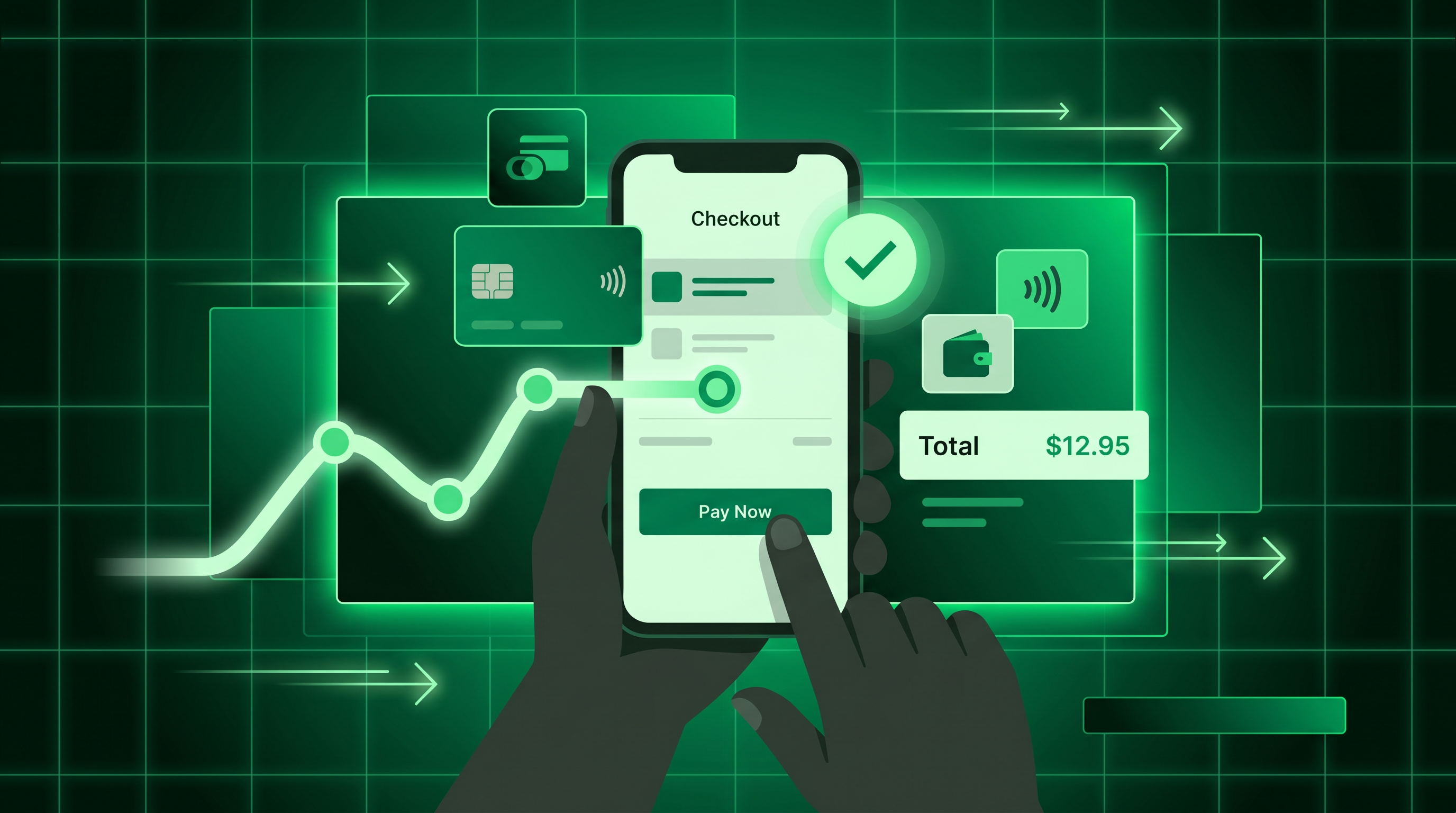
Consumers arrive at checkout with four clear expectations: their preferred payment method is available, the mobile flow wraps up in three taps or fewer, the total cost is visible before the confirmation screen, and payment status comes back immediately. When any of these are missing, they leave.
According to the Payments Consulting Network’s Ecommerce Payments Experience Report, 70% of online shoppers say payment method availability influences which merchant they complete a purchase with. For merchants selling across markets, a checkout that doesn't meet these expectations isn't just a UX annoyance. It's a revenue leak with a measurable cost per percentage point.
The four things consumers now treat as non-negotiable
Payments Consulting Network’s Ecommerce Payments Experience Report referenced above identifies a consistent pattern across consumer segments: payment-related friction, not price, not shipping, not product availability, is the leading driver of late-stage checkout abandonment.
Four expectations have moved from nice-to-have to baseline requirement.
Their preferred payment method is there: 70% of online shoppers in 2025 report that payment method availability influences which merchant they complete a purchase with. A consumer who uses Apple Pay as their default and lands on a card-form-only checkout has already hit friction before filling in a single field.
The mobile flow takes three taps or fewer: A PYMNTS research shows that mobile checkout flows requiring more than three steps have measurably higher abandonment rates than wallet-native flows. This isn't a design preference. It's an observable behavioral threshold.
The total cost is visible before the confirmation screen: Hidden fees at the final step, whether shipping, handling, or FX markup, are the most commonly cited reason for cart abandonment across e-commerce categories. Consumers who see unexpected charges at the time of confirmation don't negotiate. They leave.
Payment confirmation is immediate: In markets where real-time rails are standard, like UPI in India or Pix in Brazil, the expectation of instant payment confirmation has carried over to card-based checkout too. A 3-5 second authorization delay that would have gone unnoticed in 2022 is now perceptible friction.
Digital wallets: from preferred to expected
The Worldpay Global Payments Report documents that digital wallets now account for more than 50% of global e-commerce transaction value, up from 41% in 2023. In the US, wallets processed 37% of e-commerce value in 2025. In China, wallet dominance exceeds 85%.
The point isn't that wallets are growing. It's that on mobile, wallets have become the default first choice. A checkout that doesn't surface wallets as the primary option on mobile is presenting the wrong default to the majority of mobile shoppers.
A merchant whose mobile checkout renders a card entry form first, with wallets buried in a secondary list, is optimized for a minority of mobile transactions. Checkout instrumentation from Juspay's merchant portfolio shows that surfacing wallet options first on mobile reduces time-to-payment and improves conversion on the device type where abandonment rates are already highest.
Three wallet behaviors that checkout configuration needs to handle:
- One-tap authentication. Apple Pay and Google Pay replace card entry, expiry, and CVV with a single biometric confirmation. Any checkout flow that adds steps after wallet selection hasn't implemented the wallet correctly.
- Stored shipping and billing address. Wallet-native checkouts pre-populate address fields. Card forms that ask wallet users for address data they've already stored have created redundant friction.
- Guest checkout parity. First-time shoppers who would abandon a registration-required checkout complete wallet-based guest purchases at considerably higher rates.
Merchants who haven't configured wallet-first rendering on mobile aren't offering an inferior checkout. They're offering a checkout designed around a device behavior that no longer reflects most of their mobile traffic.
BNPL: the expectation gap by merchant category
Buy Now Pay Later has transitioned from a conversion lift to a baseline expectation across three merchant categories: fashion and apparel, consumer electronics, and travel. The FIS Global Payments Report 2025 documents BNPL adoption at 45-55% of purchase-intent consumers in these categories for mid-to-high ticket items ($150 and above).
The merchant framing has flipped. In 2022, adding BNPL was a growth tactic. In 2026, the question isn't whether adding BNPL improves conversion. It's whether its absence is pulling conversion below the category baseline.
| Category | Avg Ticket | BNPL Expectation (2025) | Abandonment Without BNPL |
| Consumer electronics | $200-$1,200 | ~55% | High |
| Fashion and apparel | $80-$400 | ~48% | Moderate to high |
| Travel and experiences | $300-$2,500 | ~45% | Moderate to high |
| Home goods and furniture | $150-$800 | ~40% | Moderate |
| Health and beauty | $40-$150 | ~25% | Low to moderate |
A note on operational complexity: different BNPL providers perform differently by geography, category, and customer segment. Klarna has stronger brand recognition in Northern Europe; Afterpay/Clearpay in the US and Australia; local BNPL providers in Southeast Asian markets. A single BNPL integration covers one provider's approval rate. A multi-BNPL configuration routes the request to the provider most likely to approve it for that customer profile. The optimization problem is the same as multi-PSP card routing.
What happens when the preferred payment method isn't there?
Consumers who reach a checkout missing their preferred payment method don't adapt. They abandon, or they go elsewhere.
The 2025 Payments Consulting Ecommerce Payments Experience Report puts numbers to this: 57% of consumers who encounter a missing preferred payment method report abandoning the purchase entirely. 24% report completing it elsewhere. Only 19% switch to an available alternate method and complete the purchase.
The common merchant assumption, that consumers will use a secondary payment method if their first choice isn't available, holds for roughly one in five cases. Four in five encounters with a missing preferred method result in lost revenue for that merchant.
Here’s the payment method gaps with the highest abandonment consequences, by market:
| Market | Most Consequential Missing Method | Consumer Abandonment Rate |
| India | UPI | Over 70% of digital-native shoppers |
| Brazil | PIX | Over 65% of smartphone shoppers |
| Germany | SEPA bank transfer | Around 45% |
| Netherlands | iDEAL | Around 60% |
| US (mobile) | Apple Pay / Google Pay | Around 35% of mobile sessions |
| UK | Open banking / Pay by Bank | Growing from around 20% |
Payment method gaps typically aren't visible in standard e-commerce analytics. A consumer who abandons because iDEAL wasn't offered shows up as a checkout abandonment, indistinguishable from someone who left because of shipping costs. Connecting checkout session data to payment configuration data is the only way to identify payment-method-specific abandonment signals.
Checkout friction: which UX problems are actually payment configuration problems
Not all checkout abandonment is a front-end problem. A meaningful portion of what shows up in UX analytics as friction comes from payment configuration decisions. The fix sits in the payment layer, not the design layer.
Unexpected 3DS challenges for returning customers: A returning customer who completed a purchase last month without a 3DS challenge and is challenged this month hasn't had a UX change. They've experienced a change in the authentication threshold applied by the merchant's 3DS configuration. If the threshold was set too broadly, returning low-risk customers would be unnecessarily friction-challenged. The fix is risk-based authentication configuration, not a UI redesign.
Slow PSP response creates a loading perception: A PSP authorization response that takes 4-6 seconds on a mobile network makes the payment button look unresponsive. From the consumer's perspective, the checkout appears broken. From the payment log, the transaction eventually succeeded. The abandonment that happened while the customer was waiting doesn't appear in the PSP's data at all. It appears as a checkout drop-off before an authorization attempt. The fix is routing latency monitoring and fallback routing to faster connectors for latency-sensitive sessions.
Card form on mobile for wallet-eligible users: A mobile session where the customer has Apple Pay enabled and the checkout renders a card form first has made a payment configuration decision that adds steps to a flow that could take one tap. This is a payment method priority configuration problem, not a UX problem.
Currency and fee surprises at confirmation: A cross-border customer who sees prices in USD throughout browse and cart, then encounters an unexpected FX conversion amount at checkout confirmation, is experiencing a payment configuration gap. Dynamic currency display is a payment layer feature, not a cart feature.
Each of these friction sources is invisible in checkout funnel analytics without instrumentation that connects session behavior to payment configuration context.
How Juspay Hyperswitch turns checkout expectations into configuration, not rework
The expectation gaps above, missing payment methods, suboptimal mobile rendering, authentication friction, and latency share one operational characteristic. For a merchant already using payment orchestration, each is a configuration change. For a merchant with one direct PSP integration, each integration is a project.
Payment method coverage without per-method integration: 300+ connectors, including wallet providers (Apple Pay, Google Pay, Samsung Pay), BNPL providers (Klarna, Afterpay, Affirm), local rails (UPI, Pix, iDEAL, SEPA Instant), and card networks, accessible through a single API integration.
Checkout SDK with wallet-first mobile rendering: The Hyperswitch checkout SDK surfaces Apple Pay and Google Pay as the primary payment options on mobile device sessions automatically, based on browser and device capability detection, without front-end code changes per wallet type.
Risk-based authentication configuration: 3DS authentication thresholds are configurable by customer segment (new vs. returning), transaction amount, BIN range, and geographic risk score. Returning low-risk customers aren't challenged unnecessarily, and high-risk transactions receive appropriate authentication.
Check out the instrumentation connected to payment analytics: Juspay's checkout layer records session events, including payment method displayed, payment method selected, and abandonment point, alongside authorization outcomes. This makes payment-configuration-driven abandonment visible in the same data layer as post-authorization analytics.
Key Takeaways
- 70% of consumers in 2025 say payment method availability influences which merchant they complete a purchase with. Checkout expectation gaps are merchant selection decisions.
- Digital wallets account for 50%+ of global e-commerce value. On mobile, wallet-first checkout rendering is now the majority-use-case default, not a preference accommodation.
- BNPL absence in electronics, fashion, and travel for mid-to-high ticket items is now a conversion drag, not a missing feature.
- 57% of consumers who encounter a missing preferred payment method abandon entirely. Only 19% switch to an available alternate method.
- A significant share of checkout abandonment attributed to UX friction is caused by payment configuration: authentication thresholds, PSP response latency, payment method priority rendering. The fix is in the payment layer, not the design layer.
- Payment orchestration converts each of these gaps from an integration project to a configuration change.
Frequently Asked Questions
What payment methods do consumers expect at checkout in 2026?
Consumer payment expectations vary by market. In the US, Apple Pay and Google Pay are expected on mobile for a majority of shoppers, and BNPL is expected for mid-to-high ticket purchases in electronics, fashion, and travel. In India, UPI is the dominant expectation for digital checkout. In Brazil, Pix. In the Netherlands, iDEAL. In Germany, SEPA bank transfer options. Globally, digital wallets now account for more than 50% of e-commerce value. Merchants without coverage for the primary local payment rail in each market they serve are offering an incomplete checkout.
Why do digital wallets specifically improve mobile conversion?
Digital wallets replace card entry, 16-digit number, expiry, CVV, billing address, with a single biometric confirmation: one touch or face scan. On mobile, where keyboard entry of card details creates measurable friction, reducing steps directly reduces the completion drop-off between add to cart and payment submitted. Merchants who surface card forms first on mobile are presenting the most friction-intensive option to users who already have a lower-friction option installed on their device.
What is the actual revenue cost of a missing BNPL option?
The direct cost is difficult to measure without A/B testing BNPL presence and absence on the same transaction mix. The FIS Global Payments Report 2025 documents that 45-55% of consumers in electronics, fashion, and travel categories expect BNPL for mid-to-high ticket items. Merchants who add BNPL to checkouts that previously lacked it in these categories typically observe conversion improvements in the 3-8% range for eligible ticket sizes. The inverse holds too: merchants removing BNPL observe declines in the same range.
How do I know whether my checkout abandonment is a UX or payment configuration issue?
The diagnostic question is: does the abandonment correlate with payment-layer events? If abandonment spikes correlate with days when PSP response times elevated, the cause is latency, which is a routing problem. If abandonment is higher for first-time customers than returning customers and the 3DS challenge rate is high for first-time buyers, the cause is authentication configuration. If abandonment is higher on mobile than desktop and your mobile checkout renders a card form first, the cause is payment method rendering order. Standard checkout funnel analytics can't surface these correlations. Connecting session behaviour data to payment configuration and authorisation event data is the only way to distinguish UX friction from payment configuration friction.
How does the Hyperswitch checkout SDK handle the display of payment methods?
The Hyperswitch checkout SDK detects device type and browser capability, then renders payment methods in priority order for the session context. On Apple device sessions with Safari, Apple Pay is the primary option. On Android sessions with Chrome, Google Pay is primary. Card form entry falls behind wallet options on mobile. Merchants configure which payment methods are enabled, and the SDK handles rendering priority based on device context without requiring per-device front-end code changes.
Which markets have the largest gap between consumer expectations and typical merchant coverage?
The largest expectation gaps are in markets where local payment rails dominate consumer preference: India (UPI), Brazil (Pix), the Netherlands (iDEAL), and Germany (SEPA bank transfer). Merchants with card-only or single-PSP checkout entering these markets encounter lower authorization rates and higher abandonment, not because their checkout experience is poor, but because the payment method most consumers in those markets use as their primary option isn't offered. Adding the local payment rail in each market is typically the highest-ROI checkout configuration change available for market entry.