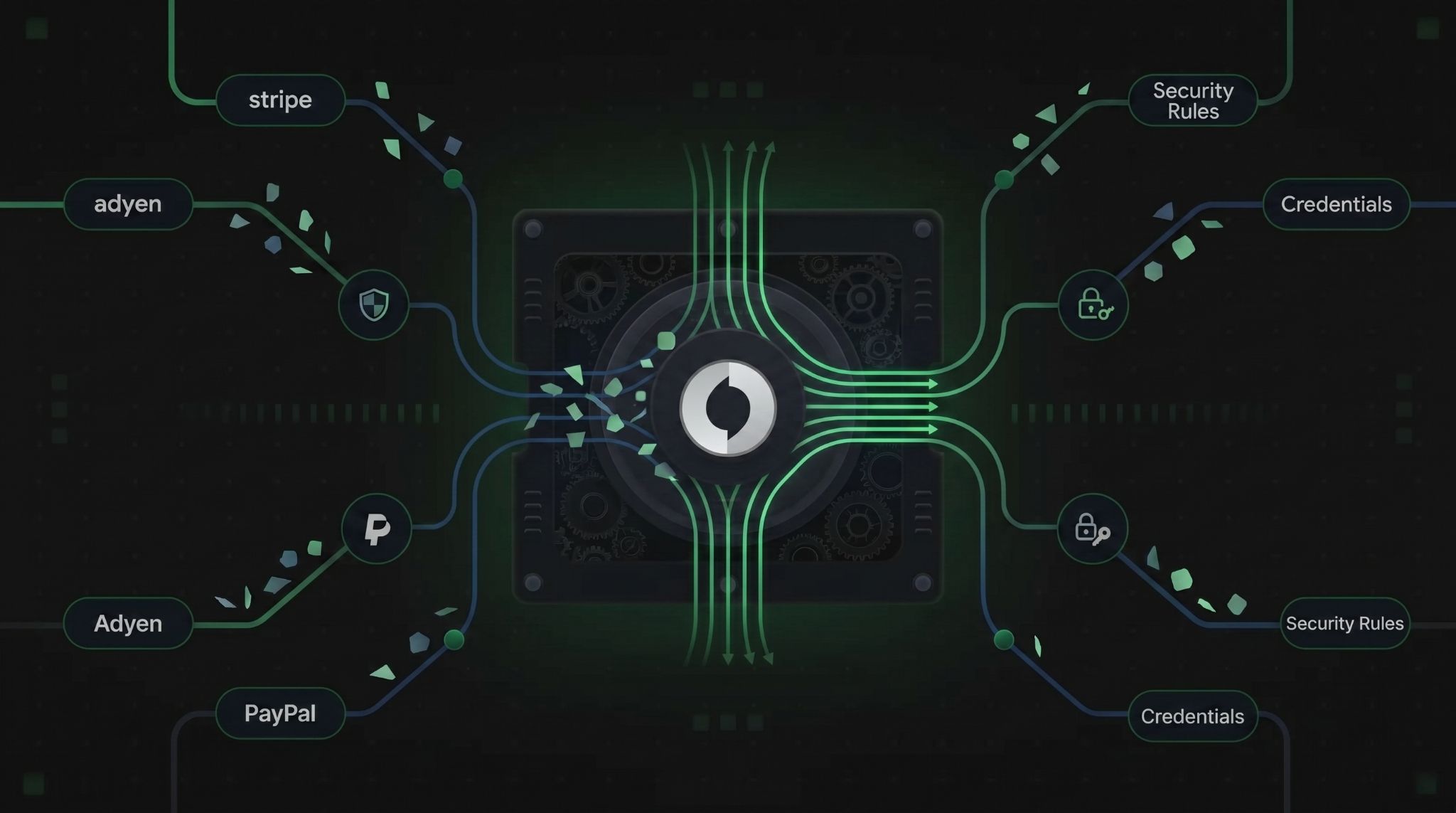
Automated payment reconciliation is not just a faster way to compare two files. At enterprise scale, it is the system that decides whether payment data can be trusted, whether expected money movement has been confirmed, and which exceptions deserve human attention.
That distinction matters. A finance team may receive order reports, bank files, internal payment records, settlement data, refund activity, fee lines on different schedules and in different formats. If reconciliation depends on manual downloads, spreadsheet cleanup, and one-off matching scripts, close cycles slow down and exceptions become harder to explain.
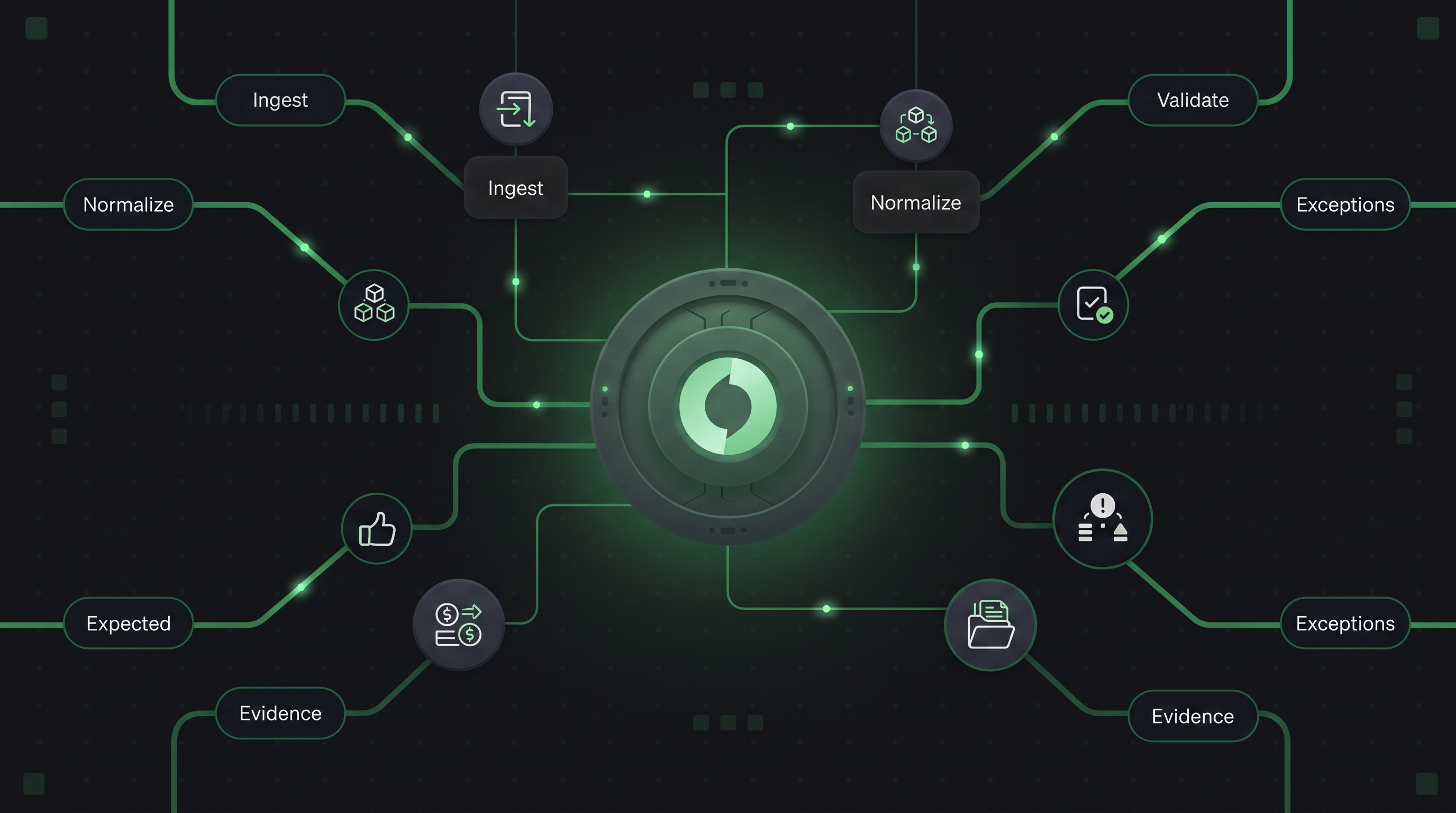
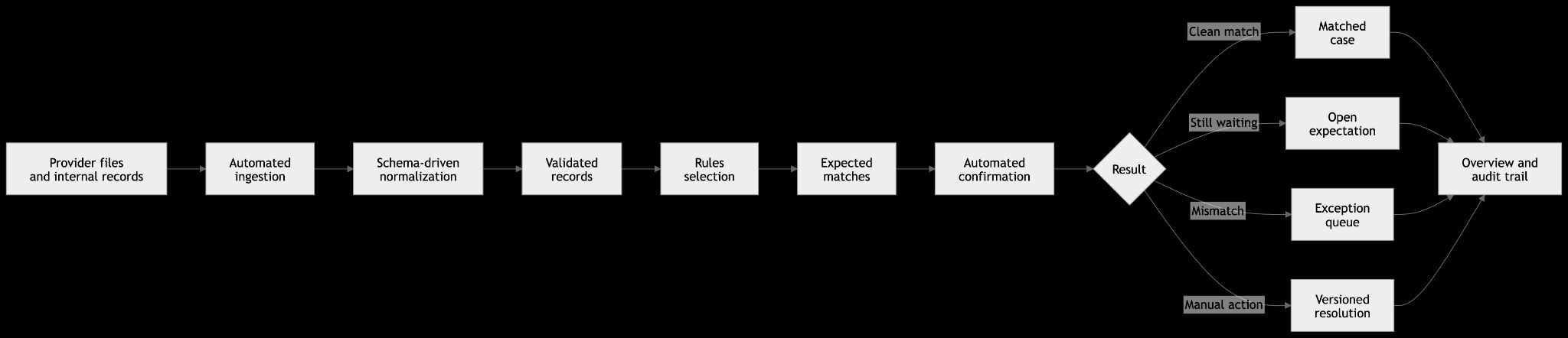
Hyperswitch Recon approaches automation as a full lifecycle: ingest data, normalize it, validate it, create expected financial movement, confirm it when counterparty data arrives, route exceptions, and preserve the evidence trail.
What automated reconciliation needs to do
A useful automated reconciliation system has to do more than mark records as matched. It must answer five operational questions:
| Question | Why it matters | Hyperswitch Recon capability |
| Did the data arrive? | Missing or delayed files can look like missing money | Ingestion configs, trigger flows, uploads, file history, and failure stages |
| Can the data be trusted? | Bad formats create false exceptions | CSV/XLSX parsing, schema mapping, typed validation, skip rules, and encrypted metadata |
| What should this record match? | Matching logic differs by provider and business model | Configurable policies with triggers, identifiers, match rules, priorities, and strategies |
| What happened after matching? | Reconciliation is a changing state, not a one-time flag | Expected, partial, mismatched, matched, void, and manual-post states |
| Can we explain the decision? | Finance and audit teams need evidence | Versioned records, resolution actions, audit timeline, and status overviews |
The core idea is simple: automation should handle the deterministic work, and people should handle only the cases where judgment is required.
The five-stage lifecycle
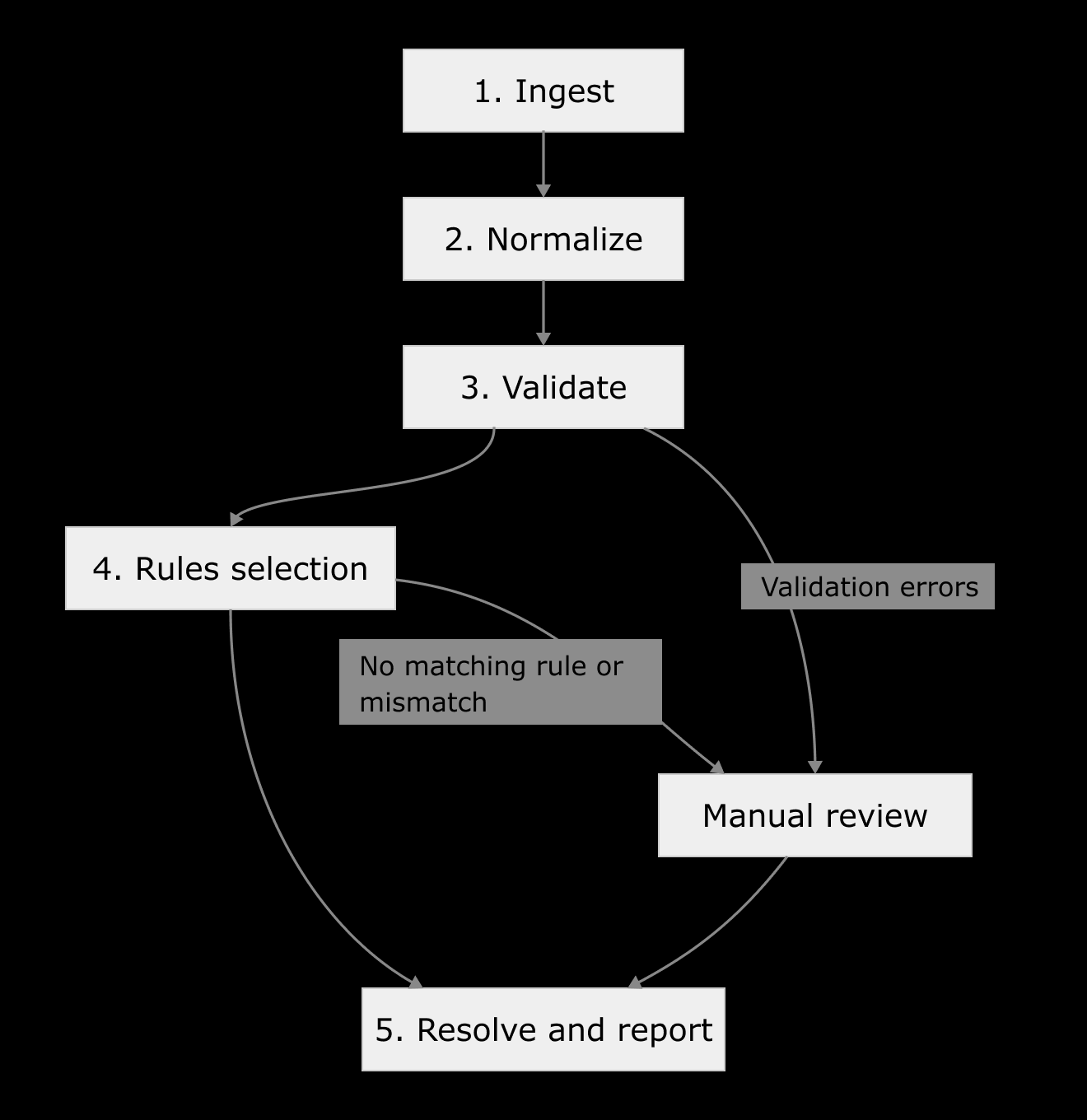
Hyperswitch Recon implements automated reconciliation as a connected pipeline. Each stage produces state that the next stage can trust.
Stage 1: Ingest payment data
Payment data can enter the system through configured provider ingestion, internal file retrieval, or manual upload. The ingestion layer stores source files and tracks each processing attempt with its own history. When something fails, the system records the stage of failure, such as parse, download, or storage.
This is important because operational teams need to know whether reconciliation failed because a file was missing, a provider payload was malformed, a download failed, or a downstream transformation produced invalid rows.
Stage 2: Normalize provider-specific formats
Every provider has its own format. Even when two reports describe the same transaction, field names, date formats, direction values, amount formats, identifiers, and metadata can differ.
Hyperswitch Recon separates normalization from matching. Files are parsed into rows, optional skip rules remove rows that should not enter reconciliation, schemas map source columns into known fields, and validation converts raw strings into typed financial data.

This separation keeps provider format changes from becoming matching-engine rewrites. When a source changes, the normalization layer can be adjusted while the reconciliation policy remains stable.
Stage 3: Validate before matching
Automated matching is only useful when the inputs are trustworthy. Hyperswitch Recon validates required financial fields such as amount, currency, balance direction, effective date, and order identifier before records move into reconciliation.
Invalid rows do not silently contaminate matching. They are collected with context and surfaced through processing history or manual review. That makes data-quality problems visible early, before they turn into unexplained mismatches.
Stage 4: Match with explicit rules
The matching layer is rules-driven. A reconciliation rule defines when it applies, which accounts are involved, which fields create the search link, which fields must match, and which strategy is required for the business pattern.
Supported matching patterns include direct one-to-one matching, one-to-many splits, many-to-one aggregation, many-to-many grouped reconciliation, and one source record split across multiple target accounts.
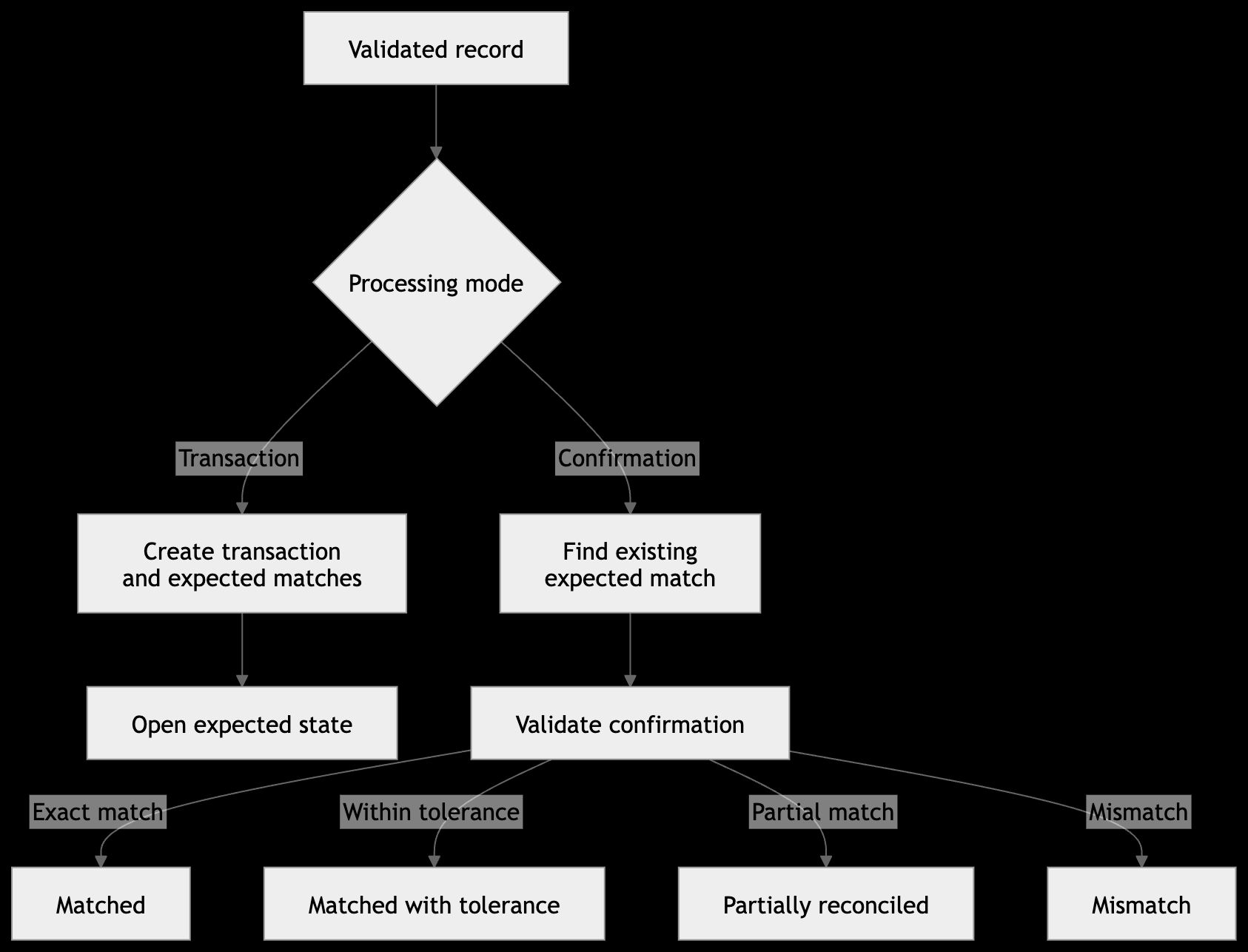
The key design is expectation tracking. In transaction mode, the system records what should happen next. In confirmation mode, it searches for those expectations and validates the arriving record against them.
That gives teams a more accurate operational picture than "matched" or "unmatched":
| State | What it tells the team |
| Expected | The source event is known, but the confirming record has not arrived yet |
| Matched automatically | The confirmation arrived and passed configured rules |
| Matched with tolerance | The variance was within an allowed band |
| Partially reconciled | Some expected records arrived, but the case is not complete |
| Over or under amount | Amount validation found a value outside the expected range |
| Data mismatch | Required business fields did not match |
| Currency mismatch | Currency validation failed |
| Split mismatch | A split or allocation rule did not reconcile |
| Manual match or force match | An operator resolved the case with an explicit action |
Stage 5: Resolve exceptions and report outcomes
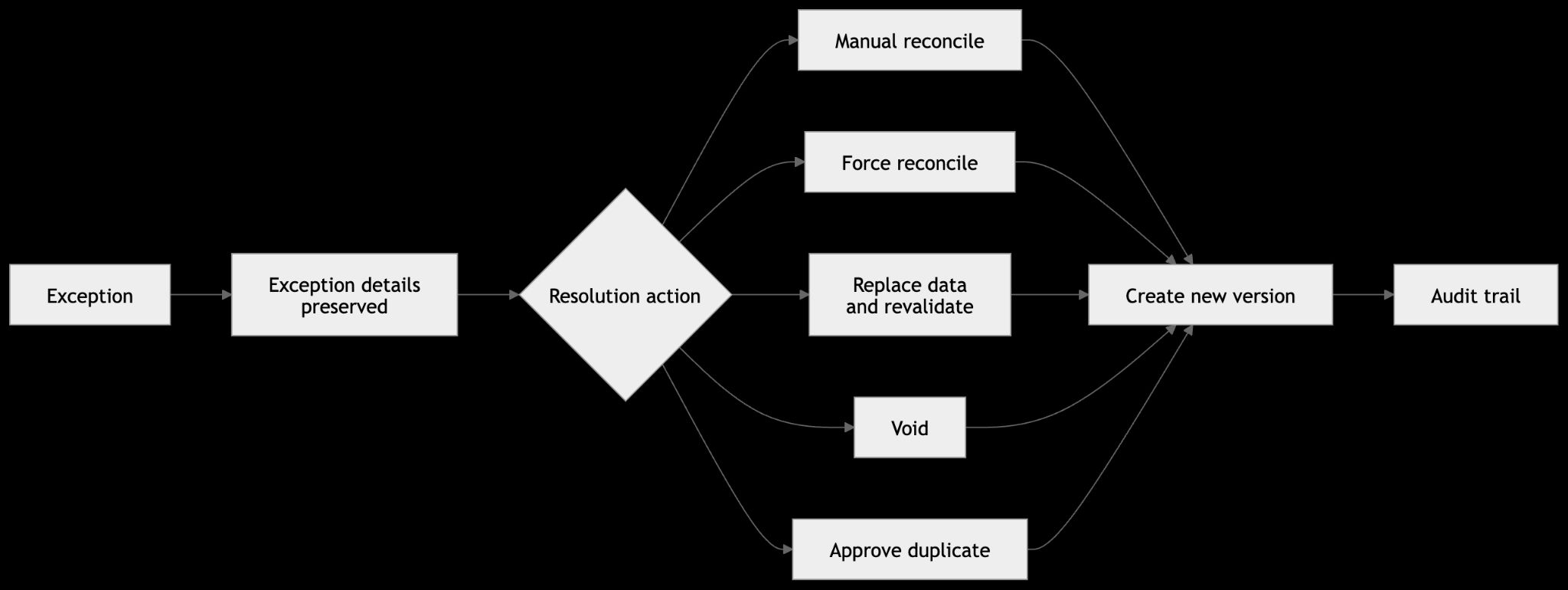
Automation should not hide exceptions. It should classify them, preserve context, and make resolution controlled.
Hyperswitch Recon routes failed or ambiguous cases into manual review with structured reasons. Operators can inspect available resolution actions, manually reconcile records, force reconcile eligible mismatches with a reason, validate replacement entry data, void records, or process duplicates when duplicate detection has intentionally stopped automation.
Every resolution creates new versioned state rather than overwriting the old state. That makes the system explainable after the fact.
Why automation becomes necessary at scale
Manual reconciliation fails gradually. At first, a team can manage a few provider files and exceptions by hand. Then the business adds another provider, another market, a new settlement flow, or a marketplace split model. The number of possible reconciliation states grows faster than the number of people reviewing them.
Automation becomes necessary when any of these conditions appear:
- Finance needs to wait for engineering to update parser scripts.
- Settlement report changes create waves of false exceptions.
- Teams cannot tell whether an exception is a true money movement issue or a data-format issue.
- Manual review queues grow even when transaction volume grows predictably.
- Close depends on downloading files, checking spreadsheets, and reconstructing decisions after the fact.
Hyperswitch Recon reduces that operational drag by making the process stateful and controllable. When enabled, the background processor can pick up pending records, process them through the same core engine used by manual triggers, and expose controls to start or stop processing. Manual APIs still exist for targeted processing, duplicate approval, and operational intervention.
This does not remove human control. It moves human attention to the places where it has the most value: exception review, rules design, and operational monitoring.
Handling ambiguous payment data
Payment data is often ambiguous. A confirmation may arrive late. A provider may split a settlement. A fee or refund may change the amount. Multiple source records may map to one target entry. A duplicate may appear in consecutive files.
Hyperswitch Recon handles ambiguity through explicit rules and statuses rather than hidden heuristics.
| Ambiguous case | How the system represents it |
| Delayed confirmation | Expected state remains open until a matching confirmation arrives |
| Partial settlement | Partially reconciled state with remaining expected records |
| Amount variance | Under or over amount status, or matched-with-tolerance when configured |
| Metadata mismatch | Data mismatch with field-level context |
| Currency issue | Currency mismatch |
| Split or allocation issue | Split mismatch |
| Duplicate input | Duplicate detection can stop automation and require approved processing |
This is a practical approach to automation: exact matches resolve cleanly, configured tolerances absorb acceptable variance, and ambiguous cases remain explainable instead of being forced into a false success state.
Metrics to track after automating
Once reconciliation is automated, the goal is not just speed. The goal is reliable automation with a shrinking exception burden.
Hyperswitch Recon exposes the building blocks for this through transaction overviews, time-series status buckets, entry status by account, balance views, ingestion and transformation history, and audit events.
| KPI | What it measures | Where the signal comes from |
| Automatic match rate | Share of cases ending in automatic or tolerance-based matched states | Transaction status overview by policy |
| Exception rate | Share of records reaching mismatch or manual-review states | Transaction and record status breakdowns |
| Pending expectation aging | How long expected confirmations remain open | Policy aging configuration and transaction time series |
| Data-quality failure rate | Rows or runs failing before matching | Ingestion and transformation history |
| Manual intervention volume | How much work still needs an operator | Manual-review events, resolution actions, and audit timeline |
| Account-level exposure | Amounts sitting in pending, expected, mismatched, matched, or posted buckets | Entry and account status overviews |
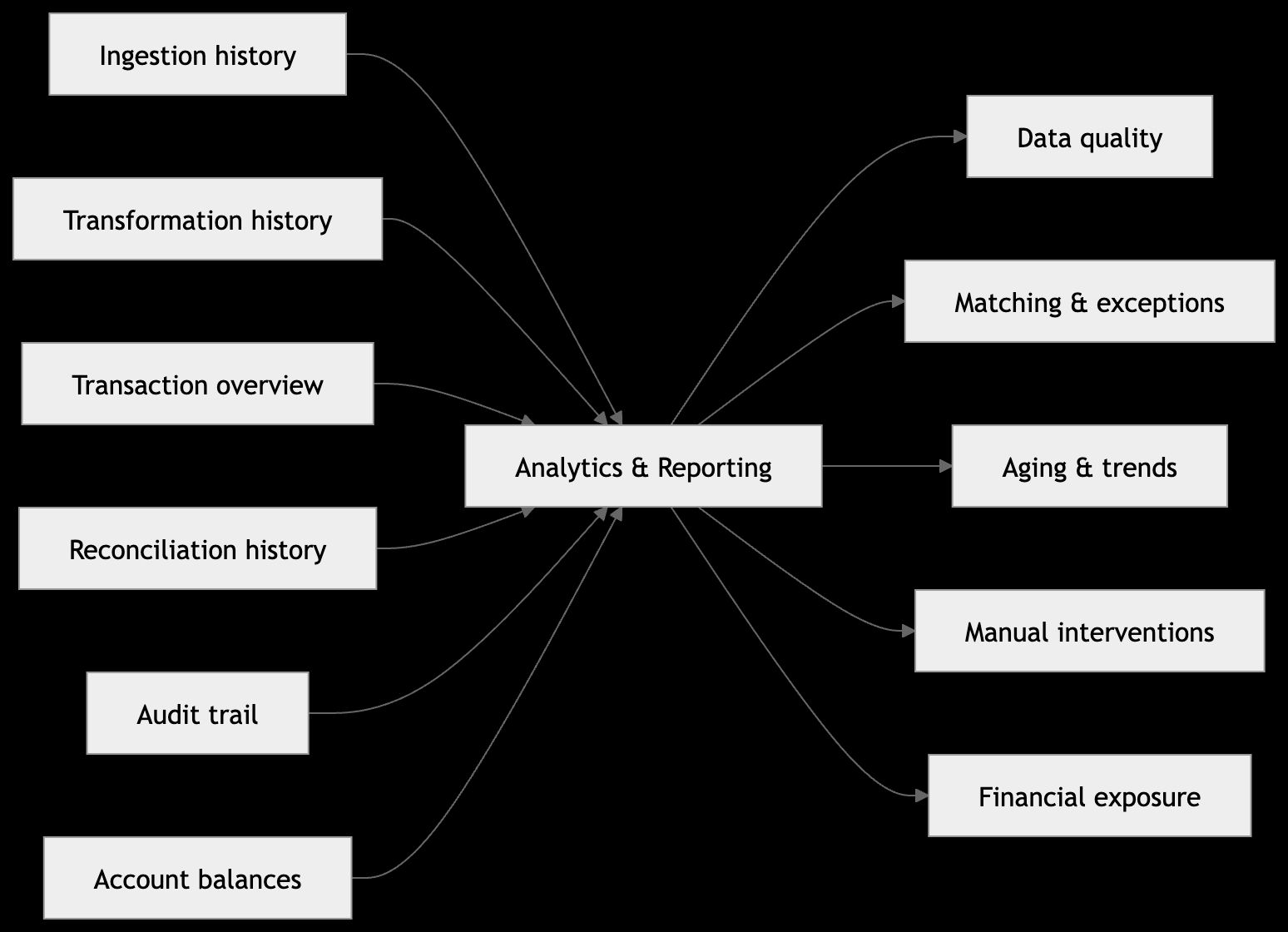
The important metric is not a single percentage. It is the relationship between metrics. For example:
- A falling match rate with rising validation errors usually points to a source-format or schema issue.
- A stable match rate with rising expected aging usually points to delayed confirmation data.
- A rising mismatch rate for one policy usually points to rule drift, provider behavior change, or a new transaction pattern.
- A high manual intervention count with low financial exposure may point to overly strict rules.
Good automation gives teams these signals early enough to fix the upstream process, not just clear the queue.
One platform, one reconciliation state machine
The largest benefit of automated reconciliation is not that a processor runs in the background. The benefit is that every stage writes into the same reconciliation model.
Files, normalized rows, expected records, confirmations, exceptions, manual actions, balances, and audit events all become connected state. That makes it possible to reason about the lifecycle of a payment operation from first file arrival to final resolution.
This model is what prevents automated reconciliation from becoming another opaque batch job. Operators can see what happened, why it happened, what remains open, and which action changed the state.
What Hyperswitch Recon enables
For finance and payment operations teams, this architecture enables a more controlled reconciliation workflow:
- Reconciliation can run through a controllable background processor while still allowing targeted manual triggers.
- Provider-specific file handling is isolated from matching logic.
- Reconciliation rules encode business rules for direct, split, aggregate, grouped, and multi-account patterns.
- Expected matches make delayed settlement and confirmation flows visible.
- Mismatch states distinguish amount, currency, data, split, duplicate, and partial cases.
- Manual resolutions are explicit, permissioned, and versioned.
- Overview and audit endpoints expose the operational health of the process.
Closing thought
Automated payment reconciliation should not be measured only by how many records it can process. It should be measured by how much trusted financial state it creates with minimal manual ambiguity.
Hyperswitch Recon is built around that standard. It automates ingestion, normalization, validation, matching, exception routing, and audit visibility while keeping the rules and outcomes explicit enough for finance, operations, and engineering teams to trust.